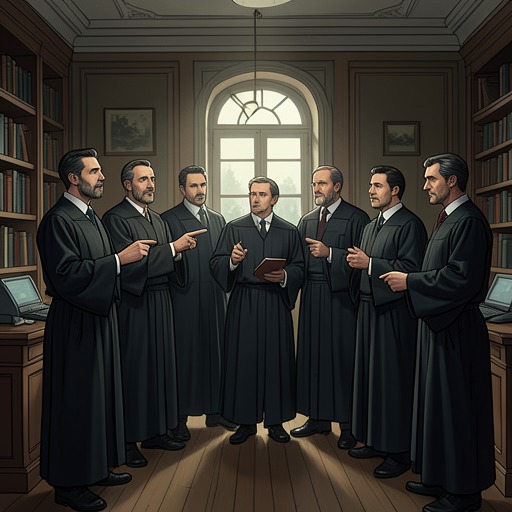
The University Cancels the English Department Chair Search
Straight ManThe University Cancels the English Department Chair Search turns a faltering appointment process into a sign of the university’s larger financial and political crisis. After months of procedural delay, the search is left without funding and is effectively abandoned. Its cancellation confirms that the English department’s leadership problem cannot be separated from a systemwide demand to plan for cuts, while sharpening the distrust among colleagues already divided over the search and its purpose.
A search reduced by delay
The search begins in September with permission to proceed, but each subsequent step is qualified or obstructed. In October, the department is reminded that the position has not been funded. By December it is allowed to create a shortlist and interview candidates at a convention; in January, permission to bring candidates to campus is denied. February brings a reminder of the hiring freeze and the lack of any guarantee that an exception will be made, even for a new chair. By March, all but six applicants have withdrawn or chosen to remain in their existing positions rather than join a search that appears so poorly managed.
In April, the dean instructs the department to narrow the list to three and rank the candidates. The instruction arrives after the narrowing has effectively happened on its own: only three of the original two hundred applicants remain. William Henry Devereaux Jr. describes the search as being in limbo. The dwindling candidate pool is not simply an administrative inconvenience; it records how repeated delays have drained the process of its prospects before the university formally ends it.
Division over the purpose of a new chair
The dispute is also about what an outside appointment could accomplish. William Henry Devereaux Jr. has opposed the search from the beginning, arguing that the department is so deeply divided and contemptuous of itself that hiring an outsider would not heal it. In his account, the search is less about finding a chair than finding a blood sacrifice: a new leader brought in to prevent any existing faculty member from gaining power. His position makes his lack of inside information about the dean’s intentions look suspicious to Finny, who sees it as possible evidence that William Henry Devereaux Jr. is trying to undermine both the search and the department’s democratic process.
The irony is that the university’s eventual decision partly vindicates his skepticism, though not through a successful political maneuver. At lunch, Jacob Rose tells him that the department’s review has been moved forward, with an internal review planned for September and an external review in October. The outside team will review three campuses at once, a cost-saving arrangement that also lets the main campus present them as parts of one geographically dispersed university. William Henry Devereaux Jr. counters that they are dispersed in ideology, philosophy, demographics, and economics as well. The administrative language of unity cannot erase the differences the department experiences.
Funding withheld and the search halted
Jacob Rose then reveals the decisive news: funding for the chair search will not come through. The university will not make the decision official until the following week, but the search’s central condition has already disappeared. Jacob Rose says that few people believe bringing in an outsider would cure the department’s problems. Since there will be no campus interviews, he also rules in Finny’s favor on the question of whether William Henry Devereaux Jr. should conduct them. Finny had argued that William Henry Devereaux Jr., having opposed the search, should not control it. The ruling gives Finny a procedural victory in a process that is no longer likely to produce a hire.
The cancellation follows a specific chain of institutional decisions rather than a sudden reversal: a position not yet funded, a hiring freeze, restricted interviews, and a narrowing pool of candidates. The timing also makes the earlier delays newly legible. The university has not merely failed to move the search forward; it has allowed the department to invest months in a process whose funding will not arrive. Jacob Rose keeps the information between himself and William Henry Devereaux Jr. until the official notice, making the pause between private knowledge and public decision part of the episode’s political texture.
A local search within a systemwide cutback
The stalled appointment sits alongside an apparently contradictory sign of investment: a large excavation for a new College of Technical Careers building. A congressman has broken his ankle while arriving for the postponed groundbreaking ceremony, and the hole awaits its symbolic first shovel of earth. To William Henry Devereaux Jr., the construction initially seems reassuring: the university is spending millions on a new facility, so perhaps rumors of faculty layoffs are false. But the excavation also becomes an image of uncertainty. The project may proceed, or the hole may signify that the promised building will never materialize; either interpretation leaves faculty unsure of what the institution intends to do.
Dickie Pope later supplies a broader context. The chancellor has directed campus executives across the university system to prepare a plan reducing staff and costs by twenty percent. Dickie emphasizes that the plan may never be implemented, but it must be drawn up. He presents reductions as a force of institutional change, invoking an efficient, leaner future as baby-boomer enrollment declines. He also reassures William Henry Devereaux Jr. that responsibility for any cuts would be understood as coming from above, leaving administrators to take the blame and allowing the department chair to emerge relatively unscathed. The chair search’s unfunded status is thus part of a larger management logic in which appointments and staffing are subject to uncertain budgets and prospective reductions.
Consequences and political afterlife
The search’s cancellation does not settle the department’s conflicts; it changes the terrain on which they are fought. Billy Quigley warns that Finny and a Jesuit colleague are planning to recall William Henry Devereaux Jr. and threatens to vote with them if William Henry Devereaux Jr. does not help him. Later, Herbert Schonberg urges him to join the union’s side in the developing labor conflict, pointing out that the English department has more votes than any other department. Herbert Schonberg says that Teddy Barnes and June Barnes have already spoken with him, underscoring that William Henry Devereaux Jr.’s colleagues and friends may be aligning against him. The failed chair search therefore leaves the department without its proposed outside leader just as competing factions seek his allegiance.
The university’s other disputes continue to unfold around the same budget pressure. Dickie Pope explains that his own budget depends on Jacob Rose’s, whose in turn depends on funding higher up the chain and on the legislature. William Henry Devereaux Jr. jokes that the budget promise would mean killing only four or five ducks, an allusion to his public threat to kill a duck a day until he receives funding. In class, he later distinguishes that comic threat from a serious one: the man making it wore a fake nose and glasses, and the absurdity lay in carrying a joke through to real consequences. That distinction resonates with the chair search itself. What first looks like a procedural delay becomes a consequential institutional decision, while the apparent promise of an orderly search gives way to the practical fact that the university will not fund it.